DNS that tells you when it's broken.
Delegation watched continuously, expected nameservers versus what the internet actually sees, with warnings before anything goes dark.
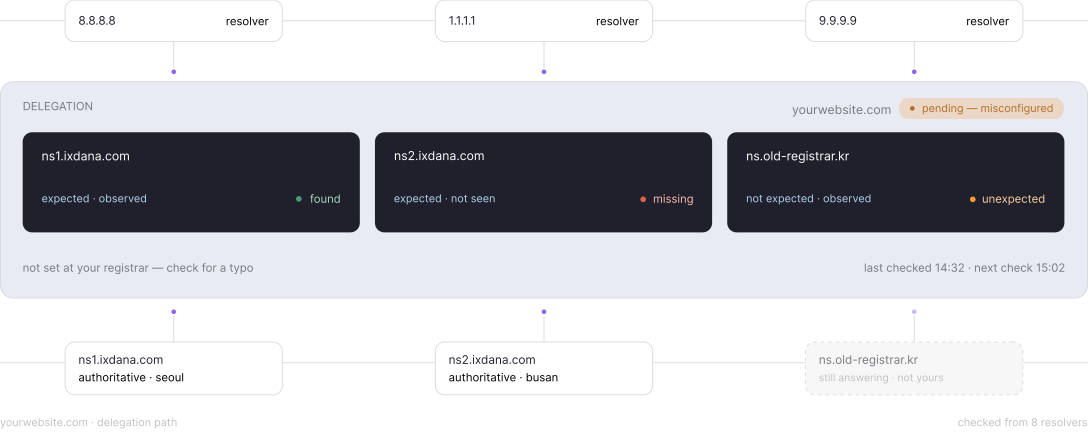
The delegation view
Half of all DNS emergencies aren't DNS at all, they're delegation: a nameserver typo at the registrar, an expired domain, a leftover default nobody noticed. The console watches for exactly this, continuously, and shows you what it sees.
| nameserver | expected | observed | status |
|---|---|---|---|
| ns1.ixdana.comfoundexpected · yesobserved · yes | yes | yes | found |
| ns2.ixdana.commissingnot set at your registrar — check for a typo: "ns2.ixdana.co" is answering insteadexpected · yesobserved · — | yes | — | missing |
| ns.old-registrar.krunexpectedyour previous provider — still receiving a share of queries until removedexpected · —observed · yes | — | yes | unexpected |
| last checked 14:32 · next check 15:02 | |||
What you set, what the internet sees, checked every 30 minutes. If they disagree, you hear it from us first.
Records without the archaeology
Most DNS panels hand you one text box and wish you luck, you supply the syntax, the trailing dots, and the folklore. This console knows what each record type needs and asks for exactly that.
Migrate in one file, leave the same way
Your zone already exists somewhere. Moving it here is a file upload, and moving it away, if that day comes, is a download. Both doors work; that's the point.
Add your domain
Type saracoffee.com. That's the whole step.
We scan your records
The console reads what your current DNS is serving and imports it
Review, edit, add
Fix anything, add what's missing, or skip the scan and upload a BIND file instead
Point your registrar
We hand you the nameservers, set them at your registrar, and you're done here
In takes minutes and no files. Out takes one file and no permission.
Free, and what that actually means
"Free" from a company you've never heard of deserves one fair question: what's the catch? Here's the complete answer,
Why it's free
DNS makes everything else on the platform work better — records created with your servers, one console for the whole stack. Charging for the connective tissue would make the platform worse to sell you. So we don't. That's the entire business logic; there is no other shoe.
Built for here
Korean or English, your DNS alerts and support arrive in the language your team actually works in.
Emails in your language
Every lifecycle notification, the delegation warning, the countdown, the all-clear, arrives in Korean or English, per your account setting.
Who answers →About UsSupport
DNS tickets answered by engineers who debug delegation for a living, describe the symptom in Korean, get the diagnosis in Korean.
Who answers →Contact Us$0 on the bill
No separate account, no separate invoice, no $0 line item to expense-report. It's simply part of the platform you're already on.
Every price, published →Pricing
Frequently Asked Questions
The questions people actually ask, answered the way we'd want them answered
DanaIX checks the delegation as soon as you update your registrar. The authoritative nameservers update quickly, but resolver caches and registry-level TTLs mean a full nameserver switch can take from several hours to 24–48 hours in some locations.
A record connects a hostname to something — for example, an A record can point app.example.com to an IP address. A subdomain zone delegates an entire namespace, such as dev.example.com, to its own nameservers and DNS management.
Yes. Add a wildcard record such as *.example.com to route requests for subdomains that do not have an explicit record. Explicit records take priority, so api.example.com can still point somewhere different.
You can manage DNS for internationalized domain names, including Korean domains, as long as the domain is registered and delegated to DanaIX nameservers. The console displays the domain safely while DNS uses its standard encoded form where required.
Yes. Import a BIND zone file, review validation feedback line by line, and apply the change only when the whole zone is valid. You can also export your zone at any time, so moving in does not create a barrier to moving out. BIND zone files are line-oriented DNS record files, and AXFR transfers represent a complete zone transfer.
Yes, where secondary-zone transfer is supported by your current DNS provider. This lets DanaIX receive a synchronized copy of the zone through AXFR, so you can validate the setup before changing delegation.
Put DNS next to the infrastructure it serves.
Create your first zone at no cost, import what you already have, and manage records, delegation, and cloud-connected DNS from one DanaIX console.