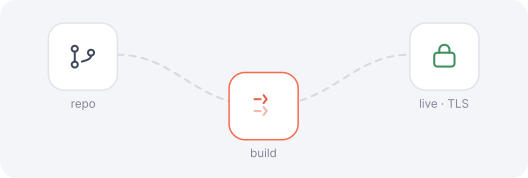
From your repository
For code you already have.
- 1
Connect your repo
GitHub, GitLab, or a Git URL.
- 2
Review the detected config
Build settings found automatically; change anything.
- 3
Deploy
Built and live on a URL with TLS.
Turn a repository into a running service, build, deploy, TLS, scaling, all handled. You write code; the platform does the rest.
Start from an app, or start from your code. Pick the door that matches where you are today, both end in the same place: a running service on the platform.
For code you already have.
GitHub, GitLab, or a Git URL.
Build settings found automatically; change anything.
Built and live on a URL with TLS.
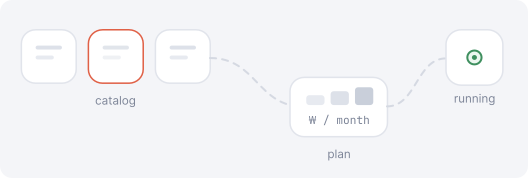
For software you want running today.
Browse the catalog and pick what you need.
Pick a size, see the $ price before you commit.
Live on its own URL, ready to use.
Both doors open onto the same platform, the same scaling, rollback, and monitoring behind every app.
The deploy is the easy part. These are the features that matter at 2am, on launch day, and in month twelve.
Every branch gets its own environment
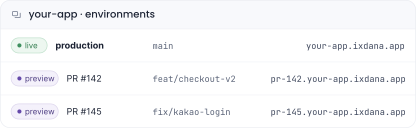
Open a pull request and get a running copy of your app on its own URL, test the change itself, not a description of it.
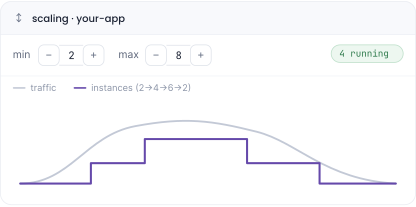
Scales when traffic arrives. Shrinks when it leaves.
Set the range; the platform adds instances under load and removes them after, you pay for the traffic you got, not the traffic you feared.
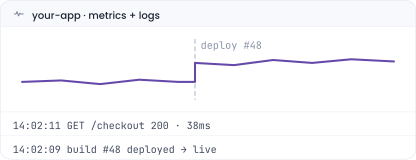
Watching from the first request
Every app streams logs and metrics into DanaIX Monitoring automatically, nothing to install, nothing to configure, one view across everything you run.
Most platforms treat Korea as a region on a dropdown. This one starts there.
Your app runs in Seoul, so your users never wait on an ocean. Single-digit latency to Korean networks — the kind Singapore and Oregon regions can't physically offer.
The price on the page is the price on the invoice. Billed in won — no exchange rate deciding what this month costs, no dollar surprise at settlement.
When you write in, an engineer answers — in Korean, from Seoul, during your working hours. Not a translated ticket queue on another continent's clock.
Every PaaS is easy until the day you need something it can't do.
runs on the same platform as
one console · one bill · one support line
Some workloads shouldn't run on a PaaS, a database you want to tune yourself, a service with unusual networking, a batch job that wants raw compute. On most platforms, that discovery means a second provider: new bills, new access controls, new latency between the halves of your stack.
On DanaIX, it means opening another tab. Spin up a Cloud Server next to your app. Move a service into Kubernetes when it earns the complexity. Same project, same permissions, same invoice, and the app you built on PaaS keeps running exactly where it is.
Grow out of the PaaS, not out of the platform.
Different apps spend differently. Pick a fixed package, pay for exactly what runs, or size a one-click app yourself, every price in won, before you commit to anything.
 01/03
Fixed monthly plans with set resources. Your app runs, the price doesn't move — the right choice when a predictable invoice matters more than squeezing every hour.
Best for: production services with steady traffic
 02/03
Metered by usage — when your app scales up, you pay for the extra; when it scales down, you stop. The natural pairing with autoscaling and spiky traffic.
Best for: variable traffic, staging apps, anything that idles
 03/03
One-click apps aren't one-size. Choose the resources your app needs — CPU, memory, storage — and see the won price update as you adjust, before you launch.
Best for: one-click apps with known workloads — a small team wiki vs. a production database
The questions people actually ask, answered the way we'd want them answered.
Run PostgreSQL, MySQL, or Redis as one-click apps next to your service — same project, private networking between them.
Redeploy any previous commit from your repo — the build runs again and replaces the broken version. Deploy history shows what was live when.
Then you outgrow the PaaS, not the platform. Move that workload to a Cloud Server or Kubernetes in the same project — same console, same bill. Your PaaS apps keep running.
Yes — point your domain and TLS is issued and renewed automatically. Manage the DNS on DanaIX too, free, if you want everything in one place.
Three ways: fixed packages, pay-as-you-go by usage, or custom-sized flavors for one-click apps — every price in won, all published on the pricing page.
Seoul. All of it — compute, storage, logs. Nothing leaves Korea.
Infrastructure, tools, and path are ready; start without complexity and continue with ease.